


TITAN 230Ah 12V Lithium Leisure Battery – High-Capacity Power for Motorhome, Marine & Off-Grid
Dispatched by TITAN Lithium
This item is sent to you directly by our partner TITAN Lithium, not from CMNAV stock. Dispatch and delivery times are set by them; any delivery charge is shown at the checkout.
Returns & warranty
TITAN Lithium’s own returns and warranty terms apply to this item. If anything isn’t right, message us first and we’ll arrange it with them for you.
High-capacity off-grid power in one industrial-format battery
2,944Wh of usable energy at 12.8V in a 385mm industrial ABS case for motorhomes, boats, cabins and custom off-grid installations. The custom TITAN BMS supports 250A continuous discharge, while individually graded LiFePO₄ cells can provide up to 245Ah in practice. At no more than 21kg, it delivers substantial usable capacity without the weight and cabling of a large lead-acid bank.
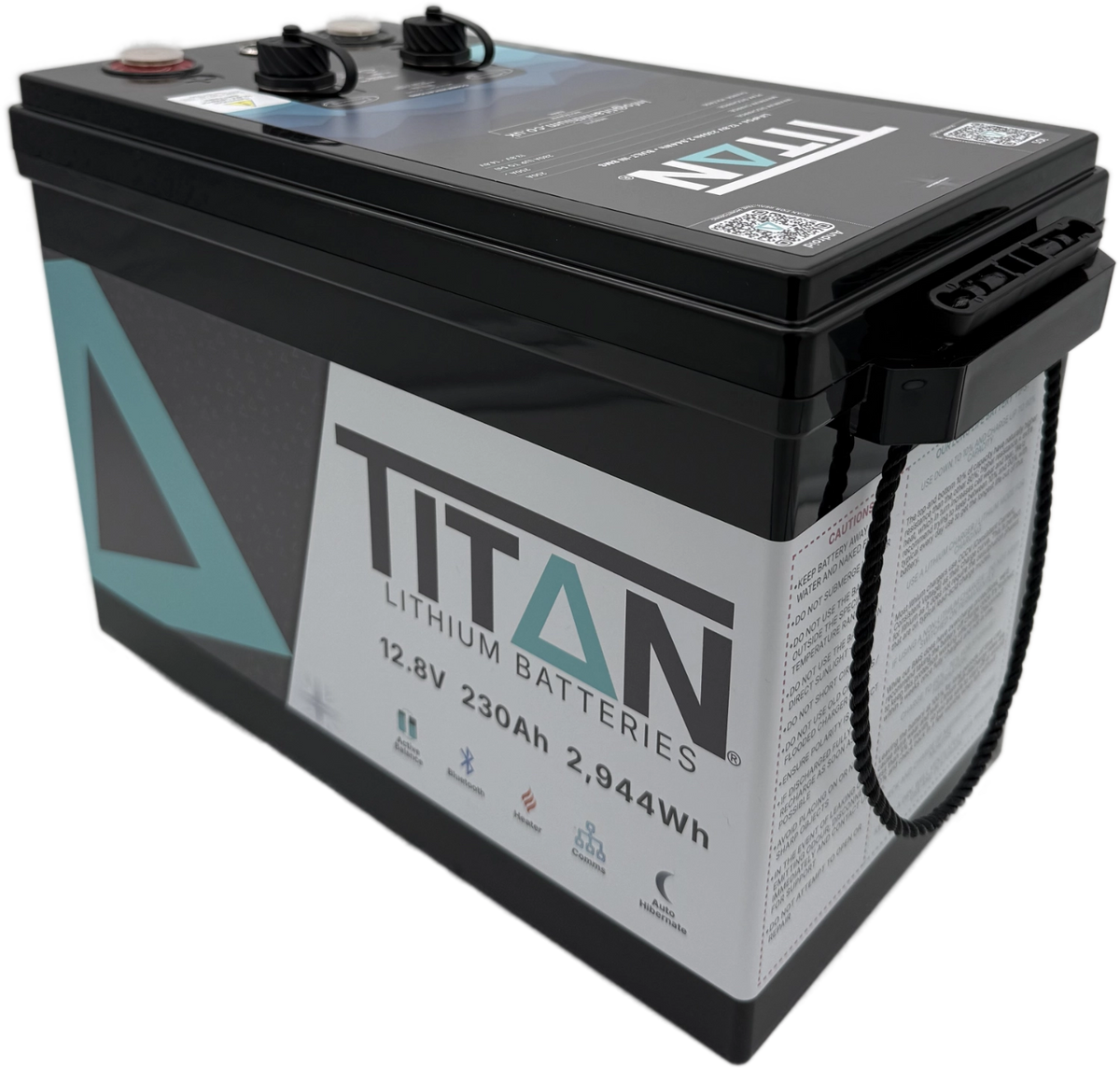
One battery. 2,944Wh of usable off-grid energy.
The 230Ah model combines 2,944Wh of usable storage at 12.8V with 250A continuous output. Its industrial ABS case is intended for floor-mounted, locker and cabinet installations where a compact under-seat DIN footprint is not required.
- 2,944Wh usable, with up to 245Ah achievable in practice
- 250A continuous BMS discharge, with 280A for 5 seconds and 300A for 500ms
- 21kg maximum — far lighter than a comparable usable-energy lead-acid bank
- Native Victron CANBUS and RS485, with NMEA2000 available on request
- Built-in heater for controlled cold-weather charging
- Lifetime, transferable warranty
The ABS case measures 385mm × 190mm × 245mm. Overall height is approximately 265mm at the communications-port covers, so use the overall figure when checking available headroom.

Will it fit your install?
The 230Ah uses TITAN’s industrial 385mm case. It suits floor-mounted installations in lockers, rear garages, cabinets and machinery spaces, subject to the available space, restraint method, ventilation, cable approach and electrical-system design.
| Large motorhomes / A-class vehicles | Suitable where the measured battery space and electrical system meet the requirements |
| Yachts / live-aboard boats | Suitable as a leisure or house battery when correctly installed and restrained |
| Van conversions / expedition vehicles | Check space carefully — this is an industrial case, not an under-seat DIN model |
| Off-grid cabins / solar storage | Suitable when the charger, inverter, protection and enclosure are correctly specified |
| Dimensions | 385mm (L) × 190mm (W) × 245mm (case H); approximately 265mm overall at the communications covers |
The cell chemistry: LiFePO₄, prismatic, Grade A
TITAN uses lithium iron phosphate (LiFePO₄) prismatic cells — a highly thermally and chemically stable lithium chemistry. No cobalt, no nickel, no acid and no off-gassing during normal use. The trade-off is a slightly lower cell voltage and lower energy density than the NMC cells commonly used in electric vehicles. In return, LiFePO₄ offers substantially longer service life: approximately 3,000 to 15,000+ cycles depending on depth of discharge and operating conditions.
Cycle life built for long-term use
A cycle is one full discharge plus one full recharge. TITAN quotes the following cycle-life figures, with expected cycle count increasing as routine depth of discharge becomes shallower:
- 100% DoD — more than 3,000 cycles
- 80% DoD — approximately 6,000 cycles
- 50% DoD — approximately 12,000 cycles
- 30% DoD — approximately 15,000+ cycles
Prismatic, not cylindrical
The long, flat prismatic cells use the rectangular case efficiently from end to end. Cylindrical cells leave gaps between cells and require many more welded connections, whereas the prismatic layout increases usable cell volume and makes module-level servicing more practical.
- Aluminium cell casings disperse heat evenly, including under high BMS loads
- The custom BMS monitors voltage, current and temperature and temporarily disconnects the pack if a protection threshold is reached
- Heater mats contact the prismatic cell surfaces directly, supporting more even cold-weather warming
Capacity, without the weight
Using TITAN’s stated usable-energy comparison, matching this 230Ah pack with flooded lead-acid requires approximately five and a half Exide ER550-class 115Ah batteries, nominally totalling around 630Ah. One TITAN 230Ah consolidates that usable capacity into a single pack, reducing the space, weight, cabling and maintenance associated with a large parallel bank.
Up to 21kg. Around 143kg of comparable lead-acid.
The manufacturer’s comparison uses approximately five and a half 26kg ER550-class batteries, or around 143kg of lead-acid. The TITAN 230Ah weighs no more than 21kg, a difference of at least 122kg. That can materially reduce axle loading, affect a boat’s trim and simplify physical installation.
99% electrically efficient
TITAN states 99% electrical efficiency. The recommended charge-current range for this model is 50A to 150A, with a maximum continuous charge current of 250A. Actual charging time and energy returned depend on charger output, temperature, system losses and battery condition.
High-draw off-grid systems, with 250A continuous output
The 250A continuous BMS provides substantial current headroom for correctly designed motorhome, marine and off-grid systems:
- Inverter systems: suitable for many high-demand appliances when the inverter’s DC input and the complete installation remain within the battery limits
- Air conditioning and water makers: high-demand comfort and marine equipment when correctly engineered
- Large compressor fridges and freezers: sustained cycling without unnecessary BMS interruption
- Water pumps, motor movers and winches: 280A for 5 seconds and 300A for 500ms to accommodate short surges
- High-current charging: 50A–150A recommended, with a 250A maximum continuous charge limit
High-power systems must use appropriately rated inverters, fuses, isolators, cable sizes and terminations. Installation should be designed around the complete system load, not the BMS rating alone.
The TITAN BMS — matched, not off-the-shelf
The battery management system sits between the cells and the external terminals, continuously controlling safe charge and discharge operation. TITAN uses a custom BMS with parameters tuned to the cells fitted inside this specific pack rather than a generic, off-the-shelf profile.
This tuning allows the cells to operate close to their genuine safe working limits without compromising protection. It can also provide additional usable headroom: the 230Ah model can achieve up to 245Ah. Capacity varies between batches, and the BMS automatically remaps its 100% reading so the app reflects the capacity available in the installed pack.
11 BMS protection functions
The custom BMS protects against over-discharge, over-voltage, under-voltage, over-current, short circuit, high temperature, low temperature and cell-balance faults, among other conditions. Protection states can reset once the cause has been corrected, following TITAN’s recovery instructions; some require the load to be removed or a charger connected. Oversized heat sinks, premium MOSFETs and correctly sized internal conductors support the 250A continuous rating.
Dual active & passive cell balancing
Passive balancing dissipates small differences between cell voltages, while active balancing moves energy between cells when larger differences appear. TITAN uses both methods: passive balancing begins at a 15mV cell difference, while active balancing starts at 30mV and operates dynamically at 1A–5A. Balancing starts above 3.4V per cell and is most relevant near full charge.
Self-heating for cold-weather charging
LiFePO₄ cells must not accept charge below 0°C without controlled heating. The built-in 85W heater system activates automatically at 0°C or below when an external charger is connected.
- The heater is supplied by the connected charger and draws approximately 5.8A / 85W
- If charger current is insufficient, the BMS can supplement the heater with up to 3.6A from the battery
- The heater switches off when the cells reach at least 10°C, allowing normal charging to proceed
- TITAN’s LFP-230 datasheet specifies a charging operating range of −30°C to 60°C with the heater enabled; cold cells are warmed before accepting charge
- Discharging is supported from −20°C to 65°C
The heater does not draw power from the battery when the charger is disconnected. Cold-weather charging depends on the connected charger providing sufficient power for heating.
Automatic & user-controlled hibernation
A deeply discharged lithium battery left connected to parasitic loads for months may become unrecoverable. This model provides two hibernation modes:
- Automatic: the BMS can enter a low-power hibernation state after a period of inactivity when its low-voltage conditions are met. Activation depends on battery activity and connected equipment
- User-controlled: TITAN’s manual identifies a built-in case button for full hibernation on the 230Ah model. This disables charge and discharge; Bluetooth is unavailable while full hibernation is active. Use the case button to wake the battery
Automatic hibernation can be cleared by connecting a charger or connecting through Bluetooth, subject to the manual’s conditions. Full button-controlled hibernation must be switched off using the case button. Continue periodic storage checks and recharge as instructed by TITAN.
Handles high inrush currents
Inverters, water pumps, motor movers and compressors can draw very high current for a fraction of a second during start-up. The TITAN BMS is tuned to tolerate legitimate surge loads without unnecessary shutdown, while retaining fast short-circuit protection specified at 1,200A within 380µs.
Inverter & device communication
Communications ports on the case allow the battery to exchange data with compatible inverters, chargers and GX devices. The default configuration supports Victron CANBUS, including VE.CAN and BMS.CAN, and is compatible with Victron DVCC. CAN and RS485 communications are built in, while other protocols, including NMEA2000, can be configured on request before dispatch.
Known working with:
- Victron GX devices (default) — CAN
- Growatt — CAN
- Sacolar — CAN
- Goodwe — CAN
- Voltronic Power — RS485
- Sofar — CAN
- Sorotec — CAN or RS485
- Deye / SunSynk — CAN or RS485
- Solis — CAN
- Luxpower — CAN
- Pylon Tech — CAN or RS485
- Sol-Ark — CAN
- SRNE — RS485
- MUST — CAN
- SMA — CAN
- MEGAREVO — CAN
- MPP Sola — RS485
- TBB Power — CAN
- Senergy — CAN
- Schneider Electric — CAN
- Aiswei — CAN
- FoxESS — CAN
- Sungrow — CAN
Protocol cable kits are available separately. Parallel battery communications use Ethernet / CAT5e. Please confirm the intended inverter, protocol and multi-battery configuration before ordering so the required setup and cabling can be checked with TITAN.
Industrial 385mm case
The ABS case measures 385mm long × 190mm wide × 245mm high. Allow approximately 265mm overall height at the communications-port covers, as well as suitable space for the power terminals, cabling, restraint and ventilation. This is a floor- or locker-mounted industrial model rather than an under-seat DIN battery.
- Charger: use a dedicated lithium profile where available. AGM or “Sealed” mode is accepted if the charger remains within the required voltage range. Target 14.2V–14.4V; float voltage should remain between 13.3V and 13.9V. Do not use reconditioning modes, and follow TITAN’s guidance for charging during storage
- Split-charge relays & DC-DC chargers: compatible when correctly specified and configured for the installation
- Terminals: high-performance copper M8 threaded terminals. Two M8 bolts and spring washers are supplied for ring-terminal cabling
- Mounting: upright on the base is optimal. The battery may also be mounted on its side or end, but must not be installed upside down. Strap it securely to a flat surface or install it in a suitable locker
- System protection: use correctly rated fusing, isolation, cabling and restraints appropriate to a battery capable of 250A continuous output
- Water resistance: TITAN states IP67 for the case, but its installation guidance rates the RJ45 communications ports at IP32 while a cable is connected. Keep connected ports clear of standing water
Bluetooth monitoring & the TITAN app
Bluetooth is built in. The free TITAN app for iOS and Android supports 10 languages and displays the battery’s operating data in real time:
- Live voltage, current in amps and power in watts
- State of charge as a percentage and in Ah
- Individual cell voltages
- Internal temperature
- Estimated time to full or empty
- Protection trip history
- Live balancing activity
The app can monitor batteries used in series or parallel and automatically recalculate totals. Whether the system uses one 230Ah battery or multiple compatible batteries in a supported bank, the displayed totals reflect the connected system.
Lifetime warranty, transferable
TITAN backs its Grade A cell leisure batteries with a warranty that lasts for the lifetime of the battery and can transfer with the vehicle or installation. Groves Batteries Ltd, TITAN’s parent company, has traded continuously since 1948.
The warranty covers premature component failure caused by manufacturing faults. Warranty terms apply, and proof of purchase plus the battery ID will be required. Please contact us first so that we can coordinate diagnosis and any claim with TITAN.
Long-term value compared with lead-acid
The 230Ah TITAN consolidates the usable energy of a much larger flooded lead-acid bank into one battery. That can reduce bank weight, interconnect cabling, installation space and the number of batteries that may eventually need replacing.
Long-term cost depends on the products being compared, local prices, depth of discharge, temperature, charge regime and actual service life. For that reason, no fixed cash saving or guaranteed lifespan is claimed here.
Module-based repair, not automatic replacement
If a serviceable component fails, TITAN can repair the affected module — such as the BMS, balance board or an individual cell — instead of automatically discarding the complete battery. This can reduce repair cost, material waste and turnaround time.
Full technical specification
| Manufacturer part number | LFP-230 |
| Nominal voltage | 12.8V |
| Rated capacity | 230Ah |
| Stored energy | 2,944Wh |
| Real achievable capacity | Up to 245Ah; batch dependent |
| Internal resistance | <10mΩ |
| Electrical efficiency | 99% stated by TITAN |
| Self-discharge | <3% per month at 25°C |
| Cell chemistry | LiFePO₄ lithium iron phosphate |
| Cell type | Prismatic, individually graded cells |
| Cycle life | >3,000 cycles at 100% DoD; longer at reduced DoD |
| BMS continuous discharge | 250A |
| BMS peak discharge | 280A for 5 seconds; 300A for 500ms |
| Maximum continuous charge | 250A |
| Recommended charge current | 50A to 150A |
| Charge voltage | 14.2V to 14.4V |
| Float voltage | 13.3V to 13.9V |
| Pack over-voltage protection | 14.4V trip; 14.0V release |
| Pack under-voltage protection | 10.0V trip; 12.0V release |
| Short-circuit protection | 1,200A at 380µs |
| Charge temperature range | −30°C to 60°C with heater enabled, as specified in TITAN’s LFP-230 datasheet |
| Discharge temperature range | −20°C to 65°C |
| Heater activation | ≤0°C when connected to a charger |
| Heater deactivation | ≥10°C |
| Heater consumption | 85W ±5% / 5.8A; charger powered, with up to 3.6A battery assistance if required |
| BMS standby draw | ≤23mA idle; ≤46mA with communications active |
| Hibernation draw | ≤800µA |
| Cell balance method | Active & passive (dual) |
| Inverter communications | CAN, RS485 & Victron VE.CAN; NMEA2000 available on request |
| Victron DVCC compatible | Yes, through BMS.CAN |
| Parallel data link | Ethernet / CAT5e |
| Bluetooth monitoring | Built in — free TITAN app for iOS & Android, supporting 10 languages |
| Dimensions | 385mm (L) × 190mm (W) × 245mm (case H), ±0.5mm; approximately 265mm overall at the communications covers |
| Weight | ≤21kg |
| Case material | ABS plastic, industrial 385mm case |
| Enclosure rating | IP67 case; RJ45 communications ports rated IP32 while a cable is connected, according to TITAN’s installation guidance |
| Terminal type | M8 threaded inserts; bolts included |
| Permitted mounting | Base, side or end; do not install upside down |
| Type approvals | IEC 62619:2022 (pack), IEC 62620 (cell), UN38.3, CE, RoHS, UKCA, UN ECE R10 (E-Mark), EMC EN 61000-6 |
| Engineering & quality control | UK-engineered, with end-pack quality control in Cheltenham by Groves Batteries Ltd |
| Warranty | Lifetime and transferable, subject to manufacturer terms |
What’s supplied
- 1 × TITAN 230Ah 12V Lithium Leisure Battery
- 2 × M8 terminal bolts with spring washers
- Access to the current TITAN datasheet and user manual
TITAN’s manual specifies a built-in hibernation button for the 230Ah model. Inverter and protocol-specific communications cable kits are available separately. Confirm the required inverter and protocol before ordering.
Important fulfilment, delivery & warranty information
To keep things fully transparent, this product is supplied and fulfilled by one of our trusted UK-based third-party partners. It is not stocked directly at our own premises.
- Partner-fulfilled product: dispatched directly by the supplier from its own fulfilment operation
- Supplier-arranged delivery: the battery weighs up to 21kg. The carrier, delivery timing and handling arrangements depend on supplier stock and destination; tracking details will be provided when available
- Manufacturer-backed lifetime warranty: technical diagnosis and module-based repair are supported by TITAN’s engineers in Cheltenham. Please contact us first so that we can coordinate any warranty request in accordance with the manufacturer’s terms
- Custom communications setup: if you need NMEA2000 or another non-default inverter protocol, state this in the order notes so that compatibility and configuration can be checked before dispatch
- Communications cables: protocol-specific cable kits are separate accessories; please confirm what your installation requires
- Support from us: if you experience an issue, contact us first and we will help coordinate the next steps with TITAN where required
Your statutory rights under UK consumer law are not affected. Where applicable, we remain your point of contact for order queries, returns guidance and support coordination.
Delivery: this item is sent to you directly by our partner TITAN Lithium, not from CMNAV stock, so dispatch and delivery times are set by them. Any delivery charge is shown at the checkout before you pay.
Returns & warranty: TITAN Lithium’s own returns and warranty terms apply to this item. If anything isn’t right, message us first and we’ll arrange it with them for you. Your statutory rights are not affected.